


Research from ACE’s 2025 National Survey on AI and Arthritis Care will be presented at the European Alliance of Associations for Rheumatology (EULAR) 2026 Congress in London, England, one of the world's largest and most influential rheumatology scientific meetings.
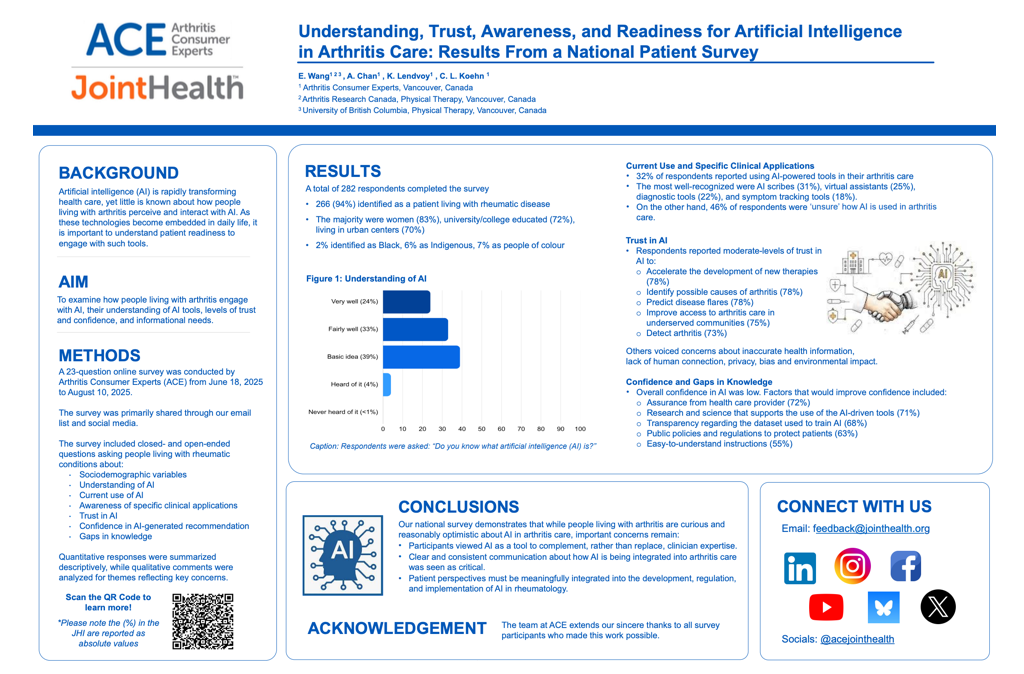
The poster, titled “Understanding Trust, Awareness, and Readiness for Artificial Intelligence in Arthritis Care: Results From a National Patient Survey”, will be presented by Ellen Wang, ACE Programs Coordinator and PhD student at the University of British Columbia, during the EULAR Poster View VIII session on June 6, 2026 (Poster ID POS1192).
As artificial intelligence (AI) becomes increasingly integrated into healthcare, ACE wanted to better understand how people living with arthritis perceive these technologies, how much they know about them, whether they trust them, and what information they need to feel confident using AI-generated health information. To answer these questions, ACE conducted a national survey of people living with rheumatic diseases across Canada between June and August 2025.
While respondents expressed considerable interest in the potential benefits of AI, the survey also identified important gaps in awareness, understanding, and confidence.
Some key findings include:
- Nearly one-third (32%) reported already using AI-powered tools as part of their arthritis care.
- Almost half (46%) were unsure how AI is currently being used in arthritis care.
- Respondents saw potential for AI to help accelerate development of new therapies, identify possible causes of arthritis, predict disease flares, improve access to care, and support earlier diagnosis.
- Trust in AI was closely linked to health care provider involvement, scientific evidence supporting AI tools, transparency regarding how AI systems are trained, and appropriate public policies and regulations to protect patients.
Participants consistently emphasized that AI should complement, not replace, health care professionals. They also identified a need for clear, plain-language information about how AI is being used in arthritis care and called for patient perspectives to be included in the development, regulation, and implementation of AI-enabled technologies.
The findings reinforce an important message: people living with arthritis are not rejecting AI. Rather, they are asking for practical guidance that helps them understand how AI works, how to evaluate AI-generated information, and how to use these tools safely and responsibly as part of managing their disease.
The survey findings are helping inform ACE’s next phase of work in this area, including the development of patient education resources focused on AI health literacy, critical evaluation of AI-generated information, and practical strategies for using AI tools to support communication with health care providers.
ACE thanks the hundreds of Canadians living with arthritis who shared their experiences and perspectives through the survey.